ChewySinew
Strength you keep, at the age when keeping it is the whole point.
An Android lifting coach for men over 40. It plans the session, tells you what to put on the bar, times your rest, and keeps every set well short of failure — because at 50 the set that hurts you is worth less than the eighty that do not.
Not on Google Play yet — in testing. Email me and I’ll send the link
The home screen
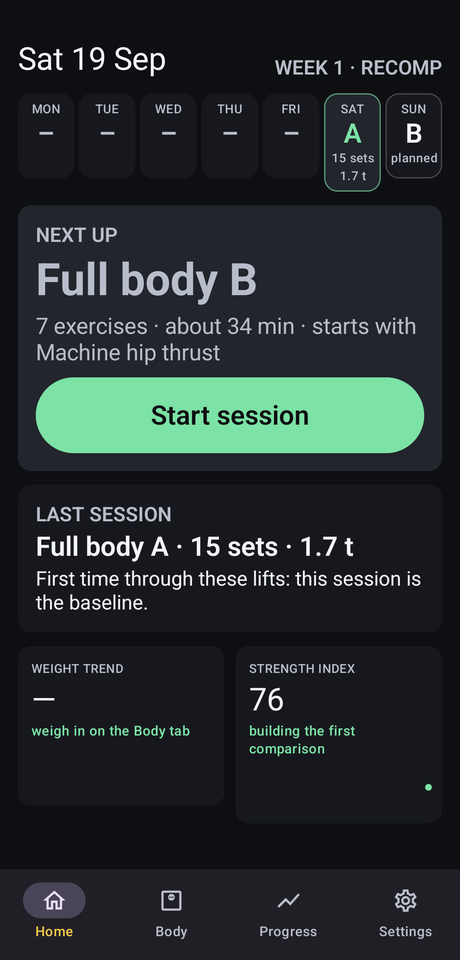
It already knows what week you are in
Open it and the week is there: what you have done, what is left, and what today is. No blank screen, no list of two hundred exercises to go hunting through.
4.1 t
3.8 t
Under it: today’s session with a start button the size of a thumb, what last session actually changed, and two small charts that fill in as you go.
In the gym
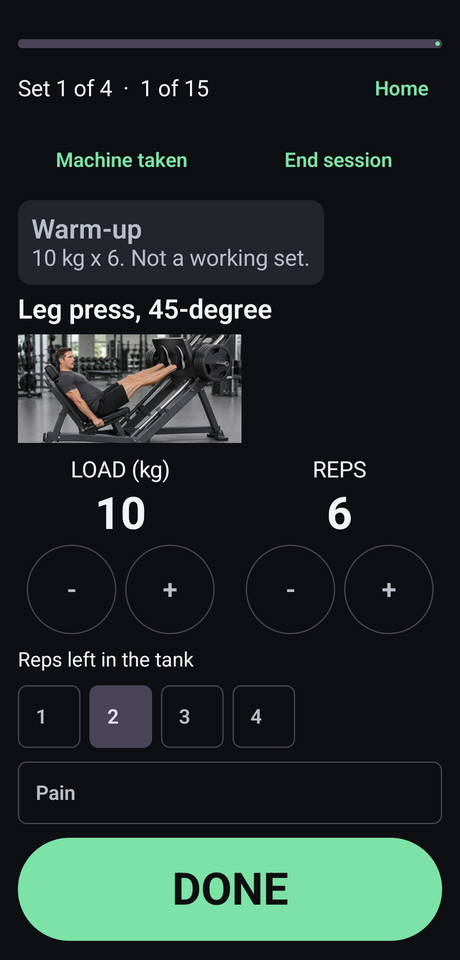
One card at a time, with the number already on it
You should be looking at the machine, not at your phone. Each card carries one set: the load, the reps, and a button.
Nothing goes to failure unless it should
You stop with a couple of good reps left in the tank. The app picks the next load from the sets you logged last time, and one tap tells you why it moved.
A swap that keeps the point of the exercise
Machine taken, or a knee objecting? The alternatives come ordered easier and joint-friendlier first, each showing what you lifted on it last time. Waiting two minutes is offered as a first-class answer, because often it is the right one.
The movement, on the card
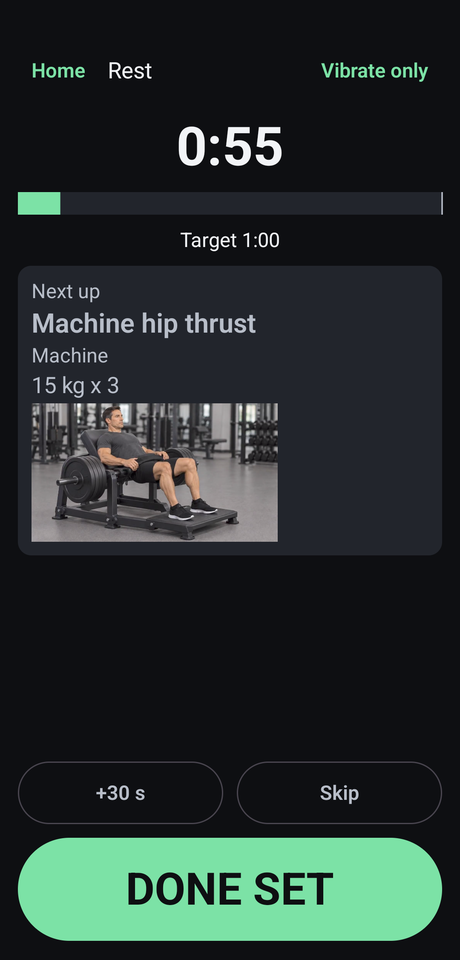
Short muted loops play while you rest, so you can see the next exercise instead of searching for it. They never touch what you are listening to.
A timer that buzzes your wrist
Vibrate-only by default: the phone stays silent, your watch taps you, and the podcast keeps running. Set it to a chime if you would rather.
A bad night changes the session, not your plans
How you slept, how recovered you feel. Answer badly and the day eases itself — lighter compounds, an extra rep in reserve — rather than writing the week off.
Your scale’s report, read on the phone
Body-composition scales email you a report. Hand it to the app and it reads the page on the device, fills in the six numbers, and waits for you to check them. Each device keeps its own line, because a gym scanner and a hand-grip scale will never agree.
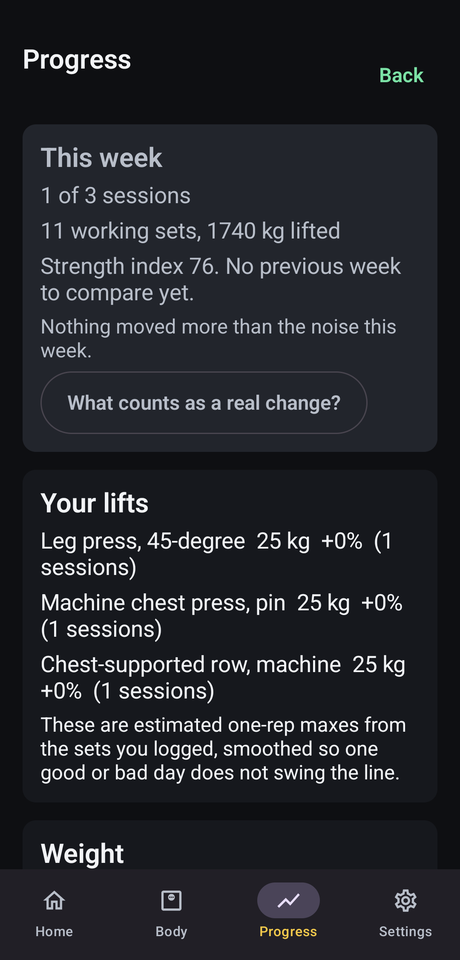
What changed, and what was just noise
A weekly read on your main lifts and your weight that separates a real move from the wobble. Most weeks the honest answer is “nothing yet”, and it says so.
The actual app
Four screens, and you have seen most of it
Photographs of the build running on a phone, from an example profile. No dashboard to configure, no feed, no streaks to keep.
Why this one
Built for a body with some history
Most training apps assume you are twenty-five and undamaged. This one asks seven plain questions first — the ones a good trainer would ask — and your answers change what it offers: machines before free weights while your form comes back, wider rep ranges, and sets that stay clear of failure.
If a joint is complaining, tap it. The app holds the load where it is instead of adding to it, offers the substitutions physiotherapists actually use, and if the same joint keeps flaring it says so plainly — three times in a fortnight is a conversation with a physio, not a heavier set.
It is a training app, not medical advice. It does not diagnose, treat or monitor anything, and where an answer matters it says so and points you at your doctor. Talk to yours before starting or changing an exercise program.
Your data
Nothing leaves the phone
You are telling this thing your weight, your blood pressure and what your knees are doing. That is not data anybody else should have.
No sign-up, no email address, no password. Install it and start.
No analytics, no crash reporting, no ads. The only thing it talks to is Google Play, and only to check that you paid.
Export the lot as JSON or as spreadsheets whenever you like. It is your file, and the export works on the free tier too.
Android’s own backup carries your history to a new phone, and only if that phone can encrypt it end to end.
Price
One payment. No subscription.
You buy it once. There is nothing to cancel, and nothing in the app can take it back off you afterwards.
Free
A$0
- Unlimited logging and unlimited history
- The three-day full-body program
- Demonstration clips for the core lifts
- Health screening and the safety rules
- JSON and spreadsheet export
Pro
US$39.99 once · US$29.99 for a launch window
- Load suggestions worked out from your own sets
- Every program: two to five days, full-body or split
- The whole clip library
- Body composition, the tape, and the scale-report import
- A calorie and protein band that learns from your weigh-ins
- The reasoning and the citation behind every rule
- A saved equipment profile per gym
Every install gets fourteen days of the full thing, starting at your first session. No card up front, nothing to cancel, and what you logged during the trial stays yours afterwards.
Where the numbers come from
Every rule has a citation behind it
How many sets, how long to rest, when to back off, when to stop — none of it is invented. Each number is tagged in the code as either evidence or a judgement call, and the app will tell you which.